The Blue Road Ending Explained: Major Spoilers Alert! Netflix’s The Blue Road takes viewers on a gripping journey filled with mysterious murders, shocking secrets, and unexpected betrayals. What initially looks like a complicated serial killer investigation slowly transforms into something far more personal, especially for detective Kim Seok.
Starring Son Suk-ku, Eita Nagayama, Jung Jae-young, and Kentaro Sakaguchi, the eight-episode Korean-Japanese crime thriller follows two detectives whose search for a murderer leads them into a disturbing chapter of history. As they begin connecting the clues, they discover that powerful people have spent decades hiding the truth.
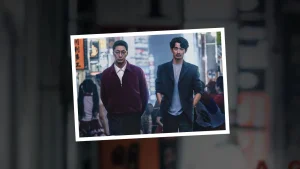

However, the biggest shock arrives in the finale, when Kim Seok learns a heartbreaking secret about his father and the man he trusted as family. So, who was responsible for the murders? Does Kim Seok survive? And what happens to Inose? Let’s unravel the ending of The Blue Road.
Warning: Major spoilers ahead!
The Blue Road Ending Explained: The Killer’s Secret Goes Back to 1987
The investigation takes an unexpected turn when Kim Seok and Inose realise that the horrifying murders they have been examining are connected to events from years earlier.
At first, Emi Shunsuke appears to be the answer to everything. His disturbing crimes, involving victims whose bodies are twisted into unnatural positions, make him the obvious suspect. But although Emi committed the murders in 2002, he wasn’t the person who originally developed this brutal method.
The truth leads back to 1987 and a clandestine organisation known as the Gráfica.
Operating under the shadow of South Korea’s former Agency for National Security Planning, this group was involved in illegal detention and torture. Vulnerable people, including those without proper documentation, were taken for interrogation and subjected to horrifying treatment.
When one of their victims died, the people responsible needed a way to conceal their activities. Instead of allowing the death to expose their operation, they manipulated the victim’s body to make the crime resemble the work of a deranged murderer.
This deception became the foundation for the killings investigated years later.
Seo Hyun-tae, who operated under several identities, including Ito Makoto and Igor, was deeply connected to these events. Emi subsequently learned the terrifying technique from him and incorporated it into his own crimes.
The detectives also discover connections involving pharmaceutical businessman Minamoto Shoichi, whose father had been associated with the Gráfica.
What seemed like a hunt for one violent criminal was actually an investigation into a much larger network of cruelty, corruption, and carefully protected secrets.
Kim Seok Discovers That His Trusted Uncle Betrayed His Family
Among all the revelations in The Blue Road, the truth about Hong Du-yeong is perhaps the most devastating for Kim Seok.
For most of his life, Kim believed that Du-yeong was his uncle, a dependable family figure who had helped his mother after his father’s mysterious disappearance.
Kim had grown up trusting him. He believed Du-yeong was someone who had stood beside his family during its most difficult years.
But Hyun-tae’s confession completely destroys that belief.
Du-yeong had actually belonged to the Gráfica and participated in its violent operations. More shockingly, he was involved in the murder of Kim’s father and the disposal of his body.
After the killing, a photograph of Kim’s mother was discovered among her husband’s belongings. Du-yeong later used this connection to enter her life, eventually becoming someone Kim regarded as a protective family member.
The revelation leaves Kim facing a painful reality: the man who appeared to help his family recover was connected to the very tragedy that destroyed it.
The story becomes even more complicated when Hyun-tae admits that he later killed Du-yeong.
Apparently, Du-yeong had begun to recognise the horror of what they had done. His growing remorse created a conflict with Hyun-tae, who remained unwilling to confront the consequences of their crimes.
For Kim, however, none of this changes the central betrayal. His entire understanding of his childhood and his father’s disappearance was built around a lie.
Inose’s Shocking Funeral: Was the Japanese Detective Really Dead?
Episode 8 initially creates the impression that Inose has died, leaving Kim Seok to pursue the remaining investigation without his trusted partner.
The apparent death is particularly heartbreaking because the two detectives have developed a strong friendship despite their early disagreements.
However, the funeral is not what it appears to be.
Inose is alive, and his supposed death is part of a carefully arranged deception.
By allowing their enemies to believe that Inose is no longer a threat, the detectives gain an advantage in their pursuit of Hyun-tae.
Inose eventually reappears and reunites with Kim during the final stage of the investigation.
Their reunion is important because Kim is now driven by something much more dangerous than his original commitment to solving the case. Having learned about his father’s murder, he is struggling to separate his duties as a detective from his desire for revenge.
And Inose may be the only person capable of stopping him from making a terrible decision.
Does Kim Seok Survive His Final Showdown With Seo Hyun-tae?
Unfortunately, Kim Seok does not survive the finale of The Blue Road.
The final confrontation unfolds in Central Asia, where Kim and Inose eventually track down Seo Hyun-tae.
By this point, Kim has already endured several shocking discoveries. But hearing Hyun-tae reveal the full extent of Du-yeong’s involvement in his father’s death pushes him close to breaking point.
His anger is understandable. He has dedicated years to finding answers, only to discover that the truth was hidden within his own family.
Overwhelmed by betrayal, Kim considers taking Hyun-tae’s life.
Inose intervenes, reminding his partner that their responsibility as police officers is to bring criminals to justice rather than execute them in anger.
This becomes the defining moral choice of Kim’s journey.
Despite everything he has suffered, Kim ultimately decides not to surrender to revenge. He lowers his weapon, choosing to remain faithful to the principles that have guided his career.
Tragically, Hyun-tae exploits that moment.
He shoots Kim in the abdomen, leaving him critically wounded. Inose immediately retaliates, shooting Hyun-tae, who falls to his death.
Although the dangerous criminal is finally stopped, the victory comes at an unbearable price.
Kim’s injuries are too severe, and he dies in Inose’s arms.
In his final moments, Kim finds comfort in knowing that he did not abandon his identity as a police officer. Instead of allowing hatred to determine his final actions, he chose what he believed was right.
His death transforms the conclusion from a conventional crime-thriller showdown into a moving story about integrity, loyalty, and the terrible cost of pursuing justice.
Why the Final Scene With Inose and Anastasia Matters
The closing moments of The Blue Road move forward to 2026, revealing how the events of the investigation continue to affect those who survived.
Inose visits Kim Seok’s grave alongside Anastasia, who has since established a life connected to police work.
The scene confirms that Kim is truly gone, but it also suggests that his influence has not disappeared.
Inose continues to carry the memory of his partner, whose determination helped expose a history that many powerful individuals wanted forgotten.
Their relationship began with professional suspicion and cultural differences, yet it eventually became one of the most meaningful connections in the story.
By returning to Kim’s grave, Inose honours not only the friend he lost but also the sacrifices that made the truth possible.
The quiet ending provides emotional closure without pretending that the suffering caused by the investigation can simply be erased.
What Is the Hidden Meaning Behind The Blue Road’s Title?
The title The Blue Road carries a deeper significance connected to the painful history of Korean displacement.
During the journey through Central Asia, Anastasia explains that the name refers to the tears shed by Koreans who were forced to leave their homeland.
Their difficult journeys, separation from familiar places, and experiences of suffering became part of a collective memory passed down through generations.
This explanation gives the title an emotional meaning that extends far beyond the central murder mystery.
Throughout the series, characters are haunted by events that occurred long before the main investigation began. Kim’s family tragedy is one example of how violence from the past continues to shape lives in the present.
The Blue Road therefore becomes a symbol of loss, survival, and the importance of remembering history.
Kim may have succeeded in uncovering the truth, but his death reminds viewers that justice cannot always undo the damage already inflicted.
Inose’s final visit to his grave reinforces this message. Even when those responsible have been stopped, the memories of their actions remain.
Will The Blue Road Return for Season 2?
As of November 21, 2026, Netflix has not announced The Blue Road Season 2.
The streaming platform identifies the show as a limited series, and the eighth episode brings the central investigation to a conclusive end.
With Kim Seok dead, Seo Hyun-tae eliminated, and the secrets surrounding the original murders exposed, the main storyline has reached its conclusion.
Nevertheless, the fictional world could potentially support another mystery involving the surviving characters or the wider network associated with the Gráfica.
For now, however, these remain possibilities rather than confirmed plans.
Also Explore: 15 Shows like Blue Road You Can’t Miss
Where Can You Watch The Blue Road?
The Blue Road premiered on Netflix on November 20, 2026. All eight episodes of the Korean-Japanese crime thriller are available to stream.
Featuring a compelling investigation, unexpected revelations, and an emotional conclusion, the series brings together a murder mystery and a deeply personal story about trust, justice, and friendship.